
How to Lower CPM on Facebook Ads: 10 Proven Strategies to Reduce Costs in 2026
Lower your Facebook CPM with 10 data-driven strategies: budget control, frequency management, audience optimization, relevance score improvement, creative testing, social proof integration, timing optimization, CTA enhancement, bidding strategy refinement, and placement selection. Includes 2026 benchmarks, step-by-step frameworks, and actionable tactics to reduce ad costs by 15-40%.
# How to Lower CPM on Facebook Ads: 10 Proven Strategies to Reduce Costs in 2026
Lowering CPM on Facebook ads directly improves your advertising efficiency, reduces customer acquisition costs, and increases return on ad spend. When CPM decreases, your cost per click, cost per lead, and cost per acquisition typically decline proportionally, allowing you to achieve more results with the same budget.
This guide provides 10 actionable strategies to reduce Facebook CPM, backed by 2026 performance data and industry benchmarks. Each tactic includes specific implementation steps, expected impact ranges, and optimization frameworks designed for experienced ecommerce advertisers managing competitive Meta campaigns.
What Is CPM and Why Does It Matter?
CPM (Cost Per Mille, from the Latin "mille" meaning thousand) measures the cost to deliver 1,000 ad impressions. An impression occurs each time your ad displays to a user, regardless of whether they interact with it. CPM is distinct from CPC (cost per click) and CPA (cost per acquisition), which measure engagement and conversion costs respectively.
CPM matters because it represents the foundational efficiency of your ad delivery. Lower CPM means you reach more users with the same budget, creating more opportunities for clicks, leads, and conversions. For awareness campaigns prioritizing reach over immediate conversions, CPM is often the primary optimization metric.
Understanding CPM is essential for budget allocation decisions. If Facebook CPM is significantly lower than search or display advertising CPM for your vertical, it signals where to concentrate advertising investment for maximum efficiency.
How to Find Your Facebook CPM
Accessing your CPM data in Meta Ads Manager requires four steps:
1. Open Ads Manager and navigate to the Campaigns tab
2. Select your desired date range using the date picker in the upper right
3. Click "Columns" and select "Performance" or customize columns
4. Scroll right to locate the CPM column showing cost per 1,000 impressions
The CPM column displays the cost to deliver 1,000 impressions for each campaign, ad set, or individual ad, depending on your selected view level.
How Facebook Calculates CPM
Facebook calculates CPM using a simple formula: total ad spend divided by total impressions, multiplied by 1,000.
Formula: CPM = (Total Ad Spend / Total Impressions) × 1,000
Example: If you spend $75 and receive 10,000 impressions, your CPM is $7.50.
This calculation applies at all campaign levels. Meta's auction system determines your actual CPM based on bid amount, ad quality, and estimated action rates compared to competing advertisers targeting the same audience.
Understanding Facebook CPM Variations
Facebook CPM varies significantly by industry, campaign objective, targeting parameters, and seasonal factors. Understanding these variations helps you identify when your costs are genuinely elevated versus normal for your context.
Key factors affecting CPM:
- Industry vertical: Competitive industries (finance, insurance, legal services, B2B software) typically show 2-3x higher CPM than consumer goods or entertainment due to higher customer lifetime value and advertiser competition
- Campaign objective: Brand awareness campaigns typically achieve lower CPM than conversion-optimized campaigns because they prioritize reach over specific actions
- Audience size: Narrow, highly competitive audiences generate elevated CPM compared to broader targeting due to limited inventory and intense competition
- Geographic targeting: Major metropolitan areas and developed markets show higher CPM than rural or emerging markets due to advertiser concentration
Seasonal variations:
- Q1 (January-March): 15-25% below annual average as advertising volume decreases post-holidays
- Q2-Q3 (April-September): Near annual average with moderate competition
- Q4 (October-December): 40-100% above average during peak holiday advertising competition (November-December)
If your CPM increases 30% or more outside peak seasons without corresponding performance improvements, systematic optimization is required.
6 Factors That Increase Facebook CPM
Understanding CPM drivers enables targeted optimization. Six primary factors influence Facebook advertising costs:
1. Audience Size and Competition
Narrow audiences with high advertiser competition generate elevated CPM. When multiple advertisers target identical user segments, Meta's auction system increases costs. Conversely, overly broad audiences may reduce relevance, also increasing CPM through poor engagement.
2. Timing and Seasonality
CPM fluctuates hourly based on advertiser demand. Seasonal patterns create predictable cost variations: November-December CPM typically increases 50-100% due to holiday advertising competition, while January CPM often drops 20-30% as campaign volume decreases.
3. Campaign Objective
Brand awareness campaigns typically achieve lower CPM than conversion-optimized campaigns because they prioritize reach over specific actions. Conversion campaigns compete in higher-value auctions, increasing CPM but theoretically delivering better-qualified users.
4. Bidding Strategy
Automatic bidding optimizes for campaign objectives but may accept higher CPM to achieve results. Manual bidding with cost caps provides direct CPM control but may limit delivery volume if caps are too restrictive.
5. Industry Vertical
Certain industries face structural CPM challenges due to high competition and valuable customer lifetime value. Insurance, finance, legal services, and B2B software consistently show 2-3x higher CPM than consumer goods or entertainment verticals.
6. Creative Fatigue and Frequency
Repeatedly showing identical creative to the same audience increases frequency scores and decreases engagement rates. As relevance declines, Meta increases CPM to maintain delivery, creating a negative cost spiral.
Strategy 1: Control Budget with Optimized Bidding
Uncontrolled automatic bidding allows Facebook's algorithm to maximize delivery without cost constraints, often resulting in inflated CPM. Strategic bidding management reduces costs while maintaining performance.
Implementation framework:
1. Start with automatic bidding optimized for link clicks (CPC)
2. Monitor performance for 5-7 days, tracking CTR and CPC
3. If CTR exceeds 1.0% consistently, switch to impressions optimization (CPM)
4. Continue monitoring—if CPM increases without proportional reach gains, revert to CPC optimization
5. Test manual bidding with cost caps once you have 50+ conversions per week
Expected impact: 10-15% CPC reduction when switching from CPC to CPM bidding after establishing strong CTR.
Advanced tactic: Use bid cap bidding (manual) to set maximum CPM thresholds. Start at 80% of current average CPM, monitor delivery volume, and adjust incrementally.
This strategy works because it prevents Meta's algorithm from overpaying for impressions while maintaining delivery efficiency through proven engagement rates.
Strategy 2: Monitor Frequency to Prevent Ad Fatigue
High frequency (showing the same ad repeatedly to identical users) generates ad fatigue, declining engagement, and increased CPM. Frequency management maintains ad relevance and cost efficiency.
Frequency benchmarks:
- Optimal: 1.5-2.5 frequency
- Acceptable: 2.5-3.5 frequency
- Problematic: 3.5+ frequency (immediate action required)
Optimization framework:
1. Access Ads Manager and add "Frequency" column to reporting
2. Identify ad sets with frequency above 3.5
3. Implement frequency caps: limit ad delivery to maximum 3 impressions per user per 7 days
4. Rotate creative every 10-14 days or when frequency exceeds 3.0
5. Expand audience size if frequency increases despite creative rotation
Expected impact: 12-20% CPM reduction when reducing frequency from 4.0+ to 2.5 or below.
Frequency cap implementation:
- Navigate to ad set settings
- Scroll to "Optimization & Delivery"
- Enable "Frequency Cap"
- Set maximum impressions (recommended: 3) and time window (recommended: 7 days)
Frequency management prevents audience saturation, maintains engagement rates, and signals to Meta's algorithm that your ads remain relevant, reducing CPM.
Frequency monitoring: Manually tracking frequency across multiple campaigns is time-intensive. Adfynx's AI Assistant automatically monitors frequency levels, flags ad sets approaching fatigue thresholds, and recommends creative rotation timing based on engagement trends. Try it free—no credit card required.
Strategy 3: Optimize Audience Targeting for Efficiency
Audience configuration directly impacts CPM through competition levels and relevance scores. Strategic audience optimization balances reach and precision.
Audience optimization framework:
Test three audience types:
1. Core Audiences: Demographic and interest-based targeting for new user acquisition
2. Custom Audiences: Website visitors, email lists, app users (typically 30-50% lower CPM)
3. Lookalike Audiences: Users similar to existing customers (balance of scale and relevance)
Implementation steps:
1. Create 1% lookalike audiences from your best customer segments (highest LTV, repeat purchasers)
2. Test broader lookalike percentages (3%, 5%, 10%) to find optimal cost-efficiency balance
3. Layer custom audiences with exclusions (recent purchasers, low-value segments)
4. Compare CPM across audience types over 14-day periods
5. Allocate budget to lowest-CPM audiences that maintain acceptable conversion rates
Expected impact: 20-30% CPM reduction when shifting from narrow interest targeting to optimized lookalike audiences.
Common mistake: Targeting audiences that are too narrow (under 500,000 users) creates intense competition and limited inventory, increasing CPM. Expand audience size if CPM is elevated despite strong relevance.
Strategic audience selection reduces CPM by accessing less competitive inventory while maintaining user quality through data-driven targeting.
Strategy 4: Improve Relevance Score to Reduce Costs
Meta's relevance diagnostics measure ad quality compared to competitors targeting the same audience. Higher relevance scores result in lower CPM and preferential ad delivery.
Relevance diagnostic components:
1. Quality Ranking: How your ad quality compares to ads competing for the same audience
2. Engagement Rate Ranking: How your expected engagement rate compares to competitors
3. Conversion Rate Ranking: How your expected conversion rate compares to competitors
Optimization framework:
1. Access Ads Manager and add "Relevance Score" columns (Quality, Engagement, Conversion rankings)
2. Identify ads with "Below Average" or "Average" rankings
3. Analyze top-performing ads (Above Average rankings) to identify successful patterns
4. Implement improvements:
- Low Quality Ranking: Improve visual quality, test different creative formats
- Low Engagement Ranking: Strengthen hooks, test more compelling copy
- Low Conversion Ranking: Optimize landing pages, clarify value propositions
5. Retire ads that remain Below Average after optimization attempts
Expected impact: 15-25% CPM reduction when improving relevance rankings from Below Average to Above Average.
Monitoring frequency: Check relevance diagnostics weekly for active campaigns, daily for new campaigns in learning phase.
Higher relevance scores signal to Meta that your ads provide positive user experiences, resulting in lower CPM as the platform rewards quality advertising.
Strategy 5: Use Compelling Creative to Drive Engagement
Creative quality directly impacts engagement rates, which influence relevance scores and CPM. High-performing creative reduces costs through improved auction competitiveness.
Creative optimization framework:
Visual elements:
- Use high-quality images (minimum 1080×1080 pixels)
- Test video content (typically 20-35% higher engagement than static images)
- Incorporate motion elements (GIFs, cinemagraphs) to capture attention
- Ensure mobile optimization (70%+ impressions occur on mobile devices)
Copy elements:
- Lead with benefit-driven headlines (not feature lists)
- Use specific numbers and data points
- Create urgency with time-limited offers
- Address objections preemptively
Format testing priority:
1. Short-form video (15-30 seconds): Highest engagement potential
2. Carousel ads: Showcase multiple products/benefits
3. Single image: Simplest to produce, good baseline performance
4. Long-form video (60-90 seconds): Best for complex products
Expected impact: 25-40% engagement rate improvement with optimized creative, resulting in 15-25% CPM reduction.
Testing cadence: Rotate creative every 10-14 days or when CTR declines 25% from peak performance.
Compelling creative maintains user attention in crowded feeds, generating engagement that Meta's algorithm rewards with lower CPM and expanded reach.
Strategy 6: Leverage Social Proof to Build Trust
Social proof elements (reviews, testimonials, user-generated content) increase ad credibility, improving engagement rates and reducing CPM through enhanced relevance.
Social proof integration tactics:
Customer reviews and ratings:
- Display star ratings in ad creative
- Quote specific customer testimonials
- Show review counts ("Trusted by 10,000+ customers")
User-generated content:
- Feature customer photos/videos using your product
- Showcase before/after results
- Highlight customer success stories
Influencer partnerships:
- Collaborate with micro-influencers (10k-100k followers) for authentic endorsements
- Use influencer content in retargeting campaigns
- Test influencer-created content against brand-produced creative
Trust indicators:
- Display security badges, certifications
- Highlight media mentions, awards
- Show customer count, years in business
Expected impact: 18-30% engagement rate improvement with social proof integration, resulting in 10-18% CPM reduction.
Best use cases: Retargeting campaigns, consideration-stage audiences, high-consideration products (expensive items, complex services).
Social proof reduces user skepticism, increasing engagement likelihood and signaling ad quality to Meta's algorithm, which reduces CPM accordingly.
Strategy 7: Optimize Ad Timing for Maximum Efficiency
Delivering ads when your target audience is most active and receptive reduces wasted impressions and improves engagement rates, lowering CPM.
Timing optimization framework:
Identify peak engagement windows:
1. Access Facebook Analytics or Google Analytics
2. Navigate to audience activity reports
3. Identify hours and days with highest engagement/conversion rates
4. Cross-reference with Meta Ads Manager delivery data
Common patterns by audience type:
- B2B professionals: Tuesday-Thursday, 8-10 AM and 1-3 PM
- Busy parents: Early morning (6-8 AM) and evening (8-10 PM)
- Students: Afternoon (3-6 PM) and late evening (9-11 PM)
- Retail shoppers: Weekends, 10 AM-2 PM
Implementation:
1. Create ad sets with dayparting (time-of-day targeting)
2. Set ad schedules to run only during identified peak windows
3. Monitor performance across time segments
4. Reallocate budget to highest-performing time periods
Expected impact: 12-22% CPM reduction when concentrating delivery during peak engagement windows.
Advanced tactic: Implement frequency caps by time period to prevent oversaturation during limited delivery windows.
Timing optimization ensures your ads reach users when they're most receptive, improving engagement rates and reducing CPM through better relevance signals.
Strategy 8: Implement Strong Calls-to-Action
Clear, compelling CTAs guide users toward desired actions, increasing engagement rates and improving relevance scores, which reduce CPM.
CTA optimization framework:
Button selection:
- Lead generation: "Download Guide," "Get Free Trial," "Sign Up"
- Ecommerce: "Shop Now," "View Products," "Get Offer"
- Consideration: "Learn More," "See How It Works," "Watch Demo"
Copy enhancement:
- Make CTAs specific and action-oriented
- Create urgency ("Limited Time," "Today Only")
- Emphasize value ("Get Your Free Guide," not just "Download")
- Test conversational vs. direct language
A/B testing priority:
1. Test CTA button text variations
2. Test CTA placement (above fold vs. below)
3. Test CTA color contrast
4. Test single vs. multiple CTAs
Expected impact: 15-25% engagement rate improvement with optimized CTAs, resulting in 8-15% CPM reduction.
Testing framework: Run A/B tests for minimum 7 days or 1,000 impressions per variant, whichever comes first.
Strong CTAs reduce user hesitation, increasing click-through rates and signaling ad quality to Meta's algorithm, which rewards engagement with lower CPM.
CTA performance analysis: Adfynx's AI-Generated Reports automatically analyze CTA performance across your campaigns, identify highest-converting button types and copy patterns, and recommend optimization priorities based on engagement data. Try it free.
Strategy 9: Test Manual Bidding with Cost Controls
Manual bidding provides direct CPM control, allowing you to set maximum acceptable costs while maintaining delivery efficiency.
Manual bidding framework:
When to use manual bidding:
- CPM consistently exceeds profitable thresholds
- Sufficient conversion volume (50+ conversions per week minimum)
- Clear understanding of maximum acceptable CPA
- Mature campaigns past learning phase
Implementation steps:
1. Calculate target CPM: (Target CPA × Current CTR × Current Conversion Rate)
2. Set bid cap at 80-90% of current average CPM
3. Monitor delivery volume over 5-7 days
4. If delivery drops below 70% of budget, increase bid cap by 10%
5. If delivery is strong, decrease bid cap by 5% to test lower thresholds
6. Find equilibrium between cost control and delivery volume
Expected impact: 15-30% CPM reduction with manual bidding, but potential 20-40% delivery volume reduction.
Risk management: Start manual bidding tests at 20-30% of total budget to avoid dramatic delivery disruptions.
Manual bidding trades delivery volume for cost efficiency. It works best when you have clear profitability thresholds and can accept reduced reach in exchange for lower costs.
Strategy 10: Optimize Ad Placements for Efficiency
Strategic placement selection concentrates budget on lowest-CPM, highest-performing positions, improving overall campaign efficiency.
Placement performance hierarchy (typical CPM from lowest to highest):
1. Facebook Feed: Moderate CPM, high engagement
2. Instagram Feed: Moderate CPM, strong visual performance
3. Facebook Right Column: Low CPM, lower engagement
4. Instagram Stories: Higher CPM, high engagement (younger audiences)
5. Audience Network: Lowest CPM, variable quality
6. Messenger: Moderate CPM, high intent
Optimization framework:
1. Start with automatic placements to gather performance data
2. After 14 days, analyze CPM and conversion rates by placement
3. Calculate cost per acquisition for each placement
4. Disable placements with CPA exceeding target by 30%+
5. Concentrate budget on 2-3 best-performing placements
Expected impact: 10-20% CPM reduction by eliminating underperforming placements.
Testing approach: Periodically (quarterly) re-test disabled placements, as performance can shift with platform updates and audience behavior changes.
Placement optimization ensures your budget concentrates on positions that deliver the best combination of low CPM and strong conversion performance.
Common Mistakes That Increase CPM
Avoid these errors that artificially inflate Facebook advertising costs:
Mistake 1: Ignoring frequency metrics
Allowing frequency to exceed 4.0 without creative rotation wastes budget on saturated audiences and increases CPM through declining engagement.
Mistake 2: Over-narrow targeting
Audiences under 500,000 users create intense competition and limited inventory, driving CPM higher despite strong relevance.
Mistake 3: Neglecting creative refresh
Running identical creative for 30+ days guarantees ad fatigue, declining performance, and increasing CPM.
Mistake 4: Automatic bidding without monitoring
Allowing Meta's algorithm to bid without cost controls can result in inflated CPM, especially during competitive periods.
Mistake 5: Ignoring relevance diagnostics
Continuing to run ads with Below Average relevance rankings wastes budget on poor-quality advertising that Meta penalizes with higher CPM.
Strategic Framework: When to Accept Higher CPM
Not all CPM increases require intervention. Distinguish between acceptable cost variations and problematic inefficiency.
Acceptable higher CPM scenarios:
New product launches: Accept 20-30% higher CPM during initial awareness phase to maximize reach and market education.
Peak seasonal periods: Q4 CPM increases of 50-100% are normal and expected. Focus on maintaining acceptable ROAS rather than absolute CPM.
Premium audience targeting: High-value B2B audiences or affluent consumer segments justify 30-50% CPM premiums if conversion rates and LTV support profitability.
Testing new creative concepts: Accept higher CPM during initial testing phases (first 3-5 days) as algorithm optimizes delivery.
Problematic CPM scenarios:
- Sustained 30%+ elevation outside peak seasons without corresponding performance improvements
- CPM increase accompanied by declining engagement rates and relevance scores
- Higher CPM resulting from technical errors or poor creative quality
- Gradual CPM creep over time without strategic changes
Always evaluate CPM in context of overall campaign profitability, not as an isolated metric.
Frequently Asked Questions
What is a good CPM for Facebook ads in 2026?
A good CPM depends on your industry and campaign objective. For ecommerce brands, $7-$12 CPM is efficient, while B2B campaigns typically run $15-$25 CPM. The key question is whether your CPM allows profitable customer acquisition given your conversion rates and product margins. Focus on cost per acquisition and ROAS rather than CPM in isolation.
How can I lower my Facebook CPM quickly?
The fastest CPM reduction tactics are: monitor and reduce frequency to below 3.0 (12-20% reduction), switch from narrow to broader audience targeting (20-30% reduction), and improve creative quality to boost engagement rates (15-25% reduction). Implement these three strategies simultaneously for maximum impact within 7-14 days.
Should I use automatic or manual bidding to lower CPM?
Start with automatic bidding to establish baseline performance and gather data. Once you have 50+ conversions per week and clear profitability thresholds, test manual bidding with cost caps at 20-30% of budget. Manual bidding provides direct CPM control but may reduce delivery volume. Most advertisers achieve best results with a hybrid approach: automatic bidding for scaling campaigns, manual bidding for mature campaigns with tight margin requirements.
Why does my Facebook CPM increase over time?
CPM increases over time typically result from creative fatigue (declining engagement from repeated exposure), audience saturation (exhausting available inventory), increased competition (more advertisers targeting your audience), or seasonal factors (Q4 holiday competition). Monitor frequency, rotate creative every 10-14 days, and expand audience size to combat gradual CPM creep.
Does lowering CPM always improve campaign performance?
No. Lower CPM with poor conversion rates is worse than moderate CPM with strong ROAS. Some tactics that reduce CPM (extremely broad targeting, low-quality placements) may decrease overall campaign profitability. Always evaluate CPM changes in context of cost per acquisition, conversion rate, and return on ad spend. The goal is profitable customer acquisition, not the lowest possible CPM.
Conclusion
Lowering Facebook CPM requires systematic optimization across multiple dimensions: bidding strategy, frequency management, audience targeting, relevance improvement, creative quality, social proof integration, timing optimization, CTA enhancement, manual bid controls, and placement selection. Implementing these 10 strategies can reduce CPM by 15-40% while maintaining or improving conversion performance.
CPM optimization is an ongoing discipline, not a one-time fix. Establish weekly monitoring routines to track frequency, relevance scores, and engagement rates. Rotate creative every 10-14 days to prevent fatigue. Test new audience segments quarterly to identify efficiency opportunities. Monitor seasonal patterns to anticipate cost fluctuations and adjust budgets accordingly.
Remember that CPM is a means to an end, not the ultimate objective. The goal is profitable customer acquisition at scale. Always evaluate CPM changes in context of overall campaign ROAS, customer lifetime value, and business profitability.
Related Resources
Want to understand why your CPM is high? Read Why Is My CPM So High on Facebook for diagnostic frameworks and root cause analysis.
Need help with creative testing? Check out Creative Testing Blind Spots for advanced creative optimization frameworks.
Looking for scaling strategies? Read The 'Crazy Method' for Meta Ads Scaling to learn proven scaling principles that maintain efficiency.
Want to optimize conversion strategies? See Maximize Conversions vs. Value Optimization for strategic frameworks that balance volume and profit.
Struggling with budget scaling? Read Meta's Daily Cycle Trap to learn why budget increases don't always improve results.
You May Also Like
Why Is My CPM So High on Facebook? 11 Data-Driven Solutions to Lower Meta Ad Costs in 2026
High Facebook CPM draining your ad budget? Learn the exact causes behind elevated CPM (broken links, audience saturation, seasonal spikes, creative fatigue) and 11 proven strategies to reduce costs: ASC optimization, broad audience targeting, DPA implementation, manual bidding, and creative diversification. Includes 2026 benchmarks and actionable frameworks.
Facebook Ads CPM for New Accounts: Complete 2026 Guide to Reducing Costs by 70%+
New Facebook ad account CPM hitting $60+? Learn the proven 3-stage warm-up strategy that reduces costs from $60 to industry average ($21) through engagement campaigns, intermediate objectives (ATC/IC), and strategic conversion optimization. Includes 2026 benchmarks, cost comparisons, and step-by-step frameworks for high-ticket products.
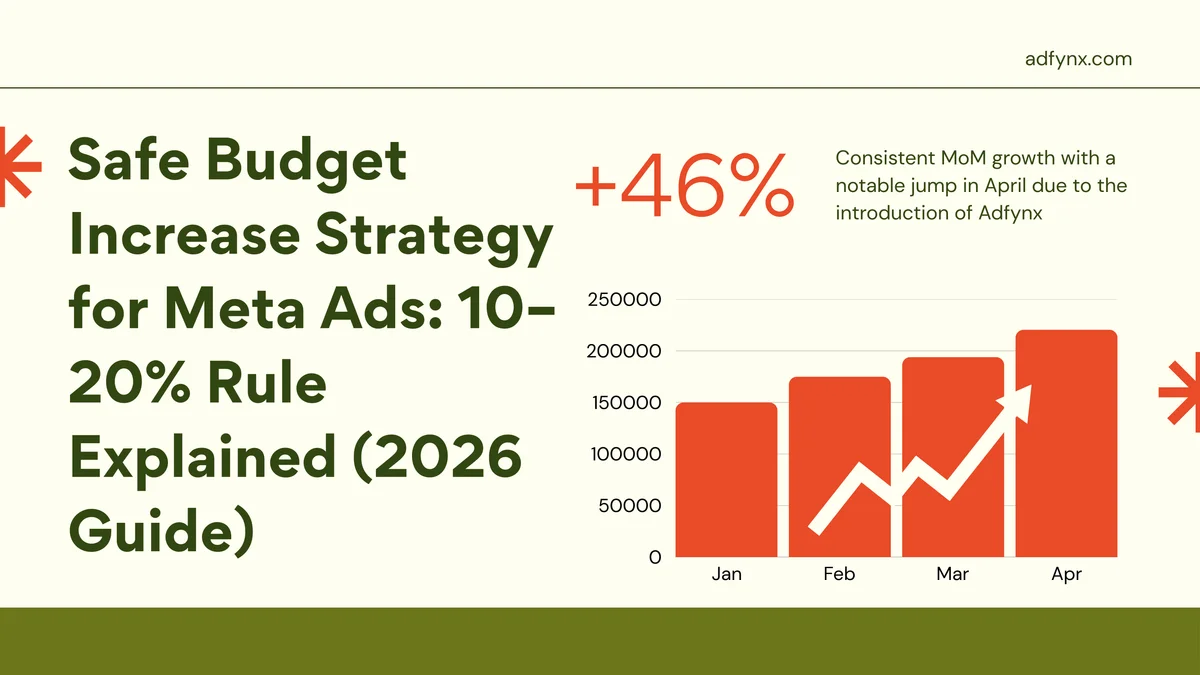
Safe Budget Increase Strategy for Meta Ads: 10–20% Rule Explained (2026 Guide)
Master safe Meta ads budget scaling with the proven 10-20% daily increase rule. Learn optimal timing (target region midnight), threshold limits (20% safe, 30-50% aggressive, >50% triggers learning reset), vertical vs horizontal scaling approaches, and when to break the rule for breakthrough scaling with broad targeting strategies.
Subscribe to Our Newsletter
Get weekly AI-powered Meta Ads insights and actionable tips
We respect your privacy. Unsubscribe at any time.