
Why Is My CPM So High on Facebook? 11 Data-Driven Solutions to Lower Meta Ad Costs in 2026
High Facebook CPM draining your ad budget? Learn the exact causes behind elevated CPM (broken links, audience saturation, seasonal spikes, creative fatigue) and 11 proven strategies to reduce costs: ASC optimization, broad audience targeting, DPA implementation, manual bidding, and creative diversification. Includes 2026 benchmarks and actionable frameworks.
# Why Is My CPM So High on Facebook? 11 Data-Driven Solutions to Lower Meta Ad Costs in 2026
High CPM on Facebook is one of the most common performance bottlenecks for ecommerce advertisers. When your cost per thousand impressions spikes, your entire campaign economics deteriorate—higher customer acquisition costs, lower ROAS, and compressed profit margins. Understanding why CPM increases and how to systematically reduce it is critical for maintaining profitable Meta ad campaigns in 2026.
This guide provides a comprehensive analysis of CPM elevation causes, industry benchmarks, and 11 actionable strategies to lower your Facebook advertising costs. Each solution includes specific implementation steps and expected impact ranges based on current platform behavior.
What Is CPM and Why Does It Matter?
CPM (Cost Per Mille) represents the cost to deliver 1,000 ad impressions on Facebook/Meta platforms. It is the foundational metric that determines your overall advertising efficiency. Higher CPM directly increases your cost per click (CPC), cost per acquisition (CPA), and reduces return on ad spend (ROAS).
CPM is determined by Meta's auction system, where advertisers compete for limited ad inventory. Your CPM reflects the intersection of demand (advertiser competition), supply (available ad placements), and ad quality (relevance score, engagement rate).
2026 Facebook CPM Benchmarks by Industry
Understanding normal CPM ranges helps identify when your costs are genuinely elevated versus industry-standard.
Ecommerce/DTC Brands:
- Normal range: $8-$15 CPM
- Competitive range: $15-$25 CPM
- Peak season (Q4): $25-$40 CPM
B2B/SaaS:
- Normal range: $15-$30 CPM
- Competitive range: $30-$50 CPM
- High-value targeting: $50-$80 CPM
Local Services:
- Normal range: $5-$12 CPM
- Competitive range: $12-$20 CPM
App Install Campaigns:
- Normal range: $6-$10 CPM
- Competitive range: $10-$18 CPM
If your CPM exceeds these ranges by 30% or more, systematic optimization is required.
Root Causes of High Facebook CPM
High CPM results from specific, identifiable factors. Understanding the root cause determines the correct solution.
1. Technical Errors in Ad Delivery
Broken links, 404 errors, or invalid redirects trigger negative user feedback signals. When users click ads and encounter technical failures, Meta's algorithm interprets this as poor ad quality and increases CPM to limit delivery.
Even minor technical issues—slow landing page load times, SSL certificate errors, or mobile incompatibility—generate negative feedback that compounds over time.
2. Narrow Audience Targeting
Highly specific audience segments (detailed interest targeting, small custom audiences, restrictive lookalikes) create intense competition for limited inventory. When multiple advertisers target the same narrow audience, CPM escalates rapidly.
Meta's auction system prioritizes advertisers willing to pay premium rates for scarce inventory. Narrow targeting forces you into high-competition auctions.
3. Ad Creative Fatigue
Repeatedly showing identical creative to the same audience generates declining engagement rates. As click-through rate (CTR) drops and relevance score decreases, Meta increases CPM to maintain delivery volume.
Creative fatigue typically manifests after 7-14 days of continuous exposure to the same audience, depending on audience size and impression frequency.
4. Seasonal Competition Spikes
During peak advertising periods (Black Friday, Cyber Monday, holiday season, back-to-school), advertiser demand surges while available inventory remains fixed. This supply-demand imbalance drives CPM increases of 50-200% during competitive windows.
Seasonal CPM elevation is normal and expected. The key is strategic planning to maintain profitability despite higher costs.
5. Low Relevance and Engagement Scores
Meta's algorithm rewards ads that generate positive user interactions (clicks, comments, shares, saves). Ads with low engagement receive lower relevance scores, resulting in higher CPM as Meta restricts delivery to protect user experience.
Relevance score is Meta's internal quality rating. While not directly visible, it manifests through CPM fluctuations and delivery patterns.
Strategy 1: Audit All Ad Links for Technical Errors
Before implementing advanced optimizations, eliminate technical failures that artificially inflate CPM.
Implementation steps:
1. Export all active ad links from Ads Manager
2. Use automated link checker tools to verify each URL
3. Test all links on mobile and desktop browsers
4. Verify landing pages load in under 3 seconds
5. Confirm landing page content matches ad messaging
6. Check for SSL certificate validity
7. Test conversion tracking pixel functionality
Expected impact: 10-25% CPM reduction if technical errors are present.
Monitoring frequency: Weekly link audits during active campaigns.
Technical link failures are among the fastest CPM reduction opportunities because they generate immediate negative feedback that Meta penalizes aggressively.
Strategy 2: Integrate Seasonal and Timely Messaging
Ads that align with current events, seasonal trends, or time-sensitive contexts generate higher engagement rates, which Meta rewards with lower CPM.
Implementation framework:
1. Identify upcoming seasonal events relevant to your product (holidays, weather changes, cultural moments)
2. Update ad copy to include seasonal language ("perfect for summer," "holiday gift guide," "back-to-school essentials")
3. Add time-limited offers or urgency elements ("limited time," "while supplies last")
4. Refresh creative visuals to match seasonal aesthetics
5. Test seasonal variants against evergreen creative
Expected impact: 15-30% engagement rate increase, 8-18% CPM reduction.
Best practices:
- Update seasonal creative 2-3 weeks before peak demand
- Maintain 60-70% evergreen creative for baseline performance
- Test seasonal messaging in low-stakes campaigns first
Seasonal relevance signals to Meta's algorithm that your ad matches current user intent, improving delivery efficiency.
Strategy 3: Implement Advantage+ Shopping Campaigns (ASC)
ASC campaigns leverage Meta's machine learning to optimize audience targeting, creative delivery, and budget allocation automatically. For brands with multiple products, ASC can reduce CPM by accessing broader, less competitive inventory.
Setup framework:
1. Create separate ASC campaigns for distinct product categories (avoid mixing unrelated products)
2. Provide 10-15 creative variants per ASC campaign
3. Set campaign budget at minimum $100/day for adequate learning
4. Allow 7-14 days for algorithm optimization before evaluation
5. Monitor performance by product category, not individual ads
Expected impact: 12-25% CPM reduction compared to manual campaigns, 15-35% improvement in cost per acquisition.
When to use ASC:
- Brands with 3+ distinct product categories
- Monthly ad spend exceeding $10,000
- Sufficient creative assets (minimum 8-10 variants)
When to avoid ASC:
- Single-product businesses
- Highly specific audience requirements
- Limited creative production capacity
ASC works by allowing Meta's algorithm to test broader audience segments and identify lower-cost inventory that manual targeting would miss.
Strategy 4: Shift from Narrow to Broad Audience Targeting
Broad audience targeting (minimal interest restrictions, large lookalike percentages, open demographics) gives Meta's algorithm maximum flexibility to find low-cost, high-intent users.
Migration framework:
1. Identify current narrow audiences (interest stacks, small custom audiences, 1% lookalikes)
2. Create test campaigns with broad targeting (no interests, 18-65+ age range, all genders, all locations in target country)
3. Allow broad campaigns to run at 20-30% of total budget for 14 days
4. Compare CPM, CPA, and ROAS between narrow and broad approaches
5. Gradually shift budget to better-performing strategy
Expected impact: 20-40% CPM reduction when transitioning from narrow interest targeting to broad audiences.
Common objections and responses:
Objection: "Broad targeting will waste budget on irrelevant users."
Response: Meta's algorithm optimizes for conversions, not impressions. Broad targeting provides data for the algorithm to identify high-intent users you wouldn't manually target.
Objection: "My product is too niche for broad targeting."
Response: Test broad targeting at 20% budget. Data often contradicts assumptions about audience requirements.
Broad targeting reduces CPM by avoiding high-competition audience segments and allowing algorithmic optimization.
Audience strategy analysis: Not sure whether your current targeting is too narrow or appropriately focused? Adfynx's AI Assistant analyzes your audience performance data, identifies high-CPM segments, and recommends optimal targeting breadth based on your product category and conversion patterns. Try it free—no credit card required.
Strategy 5: Invest in Organic Content to Reduce Paid CPM
Strong organic social presence (regular posts, engagement, community building) improves brand familiarity, which increases ad engagement rates and reduces CPM for paid campaigns.
Implementation plan:
1. Post organic content 4-7 times per week on Facebook and Instagram
2. Focus on engagement-driving formats (questions, polls, user-generated content, behind-the-scenes)
3. Respond to comments and messages within 2-4 hours
4. Build audience familiarity before launching paid campaigns
5. Repurpose top-performing organic content as paid ads
Expected impact: 10-20% higher engagement on paid ads, 8-15% CPM reduction.
Content types that reduce paid CPM:
- User-generated content (reviews, testimonials, unboxing)
- Educational content (how-to guides, product comparisons)
- Community engagement (polls, questions, challenges)
- Behind-the-scenes content (production, team, mission)
Organic content investment creates warm audiences that respond better to paid ads, signaling higher quality to Meta's algorithm.
Strategy 6: Optimize Creative for Peak Shopping Periods
During high-CPM periods (Q4 holidays, promotional events), refreshing top-performing creative with seasonal elements maintains engagement without requiring entirely new production.
Optimization framework:
1. Identify top 5 best-performing ads from the past 12 months (highest ROAS, lowest CPA)
2. Add seasonal visual elements (holiday themes, seasonal colors, relevant imagery)
3. Update copy to include time-limited offers or seasonal messaging
4. Create urgency with countdown timers or limited inventory callouts
5. Test seasonal variants alongside evergreen creative
Expected impact: 15-25% engagement rate improvement during peak periods, maintaining CPM despite increased competition.
Seasonal optimization checklist:
- Update creative 3-4 weeks before peak period
- Test seasonal variants at 30% budget allocation
- Maintain evergreen creative for baseline performance
- Monitor frequency to avoid oversaturation
Seasonal optimization maintains ad relevance during competitive periods, preventing CPM escalation from declining engagement.
Strategy 7: Diversify Creative Formats to Combat Ad Fatigue
Ad fatigue—declining performance from repeated exposure—is a primary CPM driver. Rotating creative formats maintains engagement and prevents algorithm penalties.
Creative rotation framework:
1. Develop 8-12 creative variants across multiple formats:
- User-generated content (customer photos/videos)
- Professional brand videos
- Static product images
- Carousel ads
- Text-based graphics
- Short-form video (15-30 seconds)
- Long-form video (60-90 seconds)
2. Rotate creative every 10-14 days or when frequency exceeds 3.5
3. Monitor engagement rate decline as fatigue indicator
4. Retire creative when CTR drops 30% from peak performance
5. Continuously test new creative concepts
Expected impact: 20-35% sustained engagement rate, 12-22% CPM reduction compared to static creative approach.
Creative fatigue indicators:
- Frequency above 4.0
- CTR decline of 25%+ from initial performance
- Increasing CPM despite stable targeting
- Declining relevance score
Creative diversification prevents algorithm penalties from repetitive ad exposure, maintaining efficient CPM.
Strategy 8: Monitor Click vs. View Attribution Patterns
High CPM often indicates misalignment between ad delivery and user intent. Analyzing attribution patterns reveals whether your ads reach high-intent users.
Analysis framework:
1. Access Ads Manager attribution reporting
2. Compare click-through conversions vs. view-through conversions
3. Calculate click-through rate (CTR) and benchmark against industry standards:
- Ecommerce: 1.0-2.5% CTR
- B2B: 0.5-1.5% CTR
- App install: 1.5-3.0% CTR
4. If CTR is below benchmarks by 30%+, diagnose root cause:
- Weak ad hook (first 3 seconds of video, headline)
- Audience mismatch (targeting low-intent users)
- Unclear value proposition
- Poor visual quality
5. Optimize underperforming elements systematically
Expected impact: 15-30% CTR improvement, 10-20% CPM reduction.
Attribution optimization actions:
- If view-through conversions dominate: Strengthen ad hook and call-to-action
- If click-through conversions dominate but CPM is high: Audience is correct but competition is intense—test broader targeting
- If both are low: Fundamental creative or offer problem—complete creative refresh required
Attribution analysis identifies whether high CPM stems from targeting issues or creative weakness.
Strategy 9: Test Manual Bidding with Cost Caps
Automated bidding optimizes for conversions but may accept inflated CPM. Manual bidding with cost caps provides direct CPM control.
Implementation framework:
1. Calculate target cost per acquisition (CPA) based on profit margins
2. Set cost cap at 80-90% of target CPA
3. Launch test campaign with cost cap bidding
4. Monitor delivery volume—if delivery drops below 70% of budget, increase cost cap by 10%
5. Find optimal balance between cost control and delivery volume
Expected impact: 15-30% CPM reduction, but may reduce delivery volume by 20-40%.
Cost cap strategy:
- Start conservative (70% of target CPA)
- Increase incrementally based on delivery data
- Accept reduced volume in exchange for cost efficiency
- Use for mature campaigns with established conversion data
When to use manual bidding:
- CPM consistently exceeds profitable thresholds
- Sufficient conversion volume (50+ conversions/week)
- Clear understanding of maximum acceptable CPA
When to avoid manual bidding:
- New campaigns in learning phase
- Low conversion volume (under 30/week)
- Highly variable product margins
Manual bidding trades delivery volume for cost control. It works best when you have clear profitability thresholds and sufficient conversion data.
Strategy 10: Implement Dynamic Product Ads (DPA) for Product Catalogs
DPA campaigns show personalized product recommendations based on user browsing behavior, generating higher relevance scores and lower CPM.
Setup framework:
1. Install Meta Pixel with product catalog integration
2. Upload product feed to Meta Catalog Manager
3. Create DPA campaign with two objectives:
- Retargeting: Users who viewed products but didn't purchase
- Prospecting: Broad audience with dynamic product recommendations (DABA)
4. Set up product sets by category for better optimization
5. Use dynamic creative templates that auto-populate product details
Expected impact: 25-45% CPM reduction for retargeting campaigns, 15-25% reduction for prospecting.
DPA best practices:
- Segment product catalog by price range and category
- Exclude recent purchasers (past 30 days)
- Test different lookback windows (7, 14, 30 days)
- Use dynamic creative optimization for automatic testing
Ideal use cases:
- Ecommerce brands with 20+ SKUs
- Variable product pricing
- Strong product imagery
- Established website traffic (1,000+ visitors/week)
DPA reduces CPM by delivering highly relevant ads based on demonstrated user interest, improving engagement and relevance scores.
DPA performance tracking: Managing DPA campaigns across multiple product categories requires continuous optimization. Adfynx's AI-Generated Reports automatically analyze DPA performance by product set, identify high-CPM segments, and recommend budget reallocation to maximize efficiency. Try it free.
Strategy 11: Continuous Testing and Optimization Framework
CPM optimization is not a one-time fix but an ongoing process. Systematic testing identifies emerging issues before they significantly impact costs.
Weekly optimization routine:
1. Monday: Review CPM trends across all campaigns—identify 20%+ increases
2. Tuesday: Audit links and landing pages for technical issues
3. Wednesday: Analyze creative performance—retire fatigued ads, launch new variants
4. Thursday: Review audience performance—test broader targeting for high-CPM segments
5. Friday: Analyze attribution data—optimize for high-intent user patterns
Monthly strategic review:
1. Compare CPM to industry benchmarks
2. Evaluate seasonal trends and plan creative updates
3. Test new campaign structures (ASC, DPA, manual bidding)
4. Analyze competitor activity and market conditions
5. Adjust budget allocation based on efficiency data
Expected impact: 10-15% sustained CPM reduction through continuous optimization.
Key performance indicators to monitor:
- CPM trend (week-over-week, month-over-month)
- CTR and engagement rate
- Relevance score indicators (delivery patterns)
- Attribution mix (click vs. view)
- Frequency levels
Continuous optimization prevents CPM creep and maintains campaign efficiency over time.
Common Mistakes That Increase CPM
Avoid these errors that artificially inflate Facebook advertising costs:
Mistake 1: Pausing campaigns during high-CPM periods
Stopping campaigns during seasonal spikes (Q4) forfeits market share and requires expensive re-learning when restarting. Better strategy: Reduce budget by 30-50% but maintain presence.
Mistake 2: Over-optimizing for CPM alone
Low CPM with poor conversion rates is worse than moderate CPM with strong ROAS. Always evaluate CPM in context of overall campaign profitability.
Mistake 3: Ignoring organic content strategy
Paid ads without organic presence generate lower engagement and higher CPM. Invest 10-15% of ad budget into organic content production.
Mistake 4: Using identical creative across all campaigns
Creative fatigue compounds across campaigns. Develop unique creative for each major campaign or audience segment.
Mistake 5: Setting unrealistic cost caps
Overly aggressive cost caps prevent delivery and force algorithm into low-quality inventory. Start conservative and adjust based on data.
When High CPM Is Normal vs. Problematic
Not all CPM increases require intervention. Distinguish between normal fluctuations and systematic problems.
Normal CPM increases:
- Seasonal competition (Q4: 50-100% increase is standard)
- New campaign learning phase (first 7-14 days)
- Audience expansion testing (exploring new segments)
- Premium placement testing (Instagram Stories, Reels)
Problematic CPM increases:
- Sustained 30%+ elevation outside peak seasons
- CPM increase accompanied by declining ROAS
- Technical errors causing negative feedback
- Creative fatigue with declining engagement
Validation step: Before making major changes, verify whether competitors experience similar CPM trends. Industry-wide increases suggest market conditions rather than account-specific issues.
Strategic Framework: Balancing CPM and Business Objectives
CPM optimization must align with overall business goals, not exist in isolation.
Scenario 1: New product launch
- Accept 20-30% higher CPM for maximum reach
- Prioritize brand awareness over immediate efficiency
- Shift to efficiency optimization after 30-60 days
Scenario 2: Mature product scaling
- Aggressively optimize CPM (target 10-15% below industry benchmark)
- Use broad targeting and ASC for efficiency
- Implement DPA for retargeting
Scenario 3: Promotional period
- Expect 40-80% CPM increase during peak competition
- Focus on maintaining ROAS rather than absolute CPM
- Pre-build creative and audiences before peak period
Scenario 4: Profit margin pressure
- Implement manual bidding with strict cost caps
- Reduce audience size to highest-intent segments
- Accept lower volume in exchange for profitability
The optimal CPM strategy depends on business stage, product margins, and growth objectives.
Frequently Asked Questions
What is a good CPM for Facebook ads in 2026?
A good CPM depends on your industry and campaign objective. For ecommerce brands, $8-$15 CPM is considered efficient, $15-$25 is competitive, and above $25 indicates optimization opportunities. B2B campaigns typically run $15-$30 CPM. The key metric is whether your CPM allows profitable customer acquisition given your product margins and conversion rates.
Why does my Facebook CPM increase suddenly?
Sudden CPM increases typically result from four factors: seasonal competition spikes (holidays, promotional periods), creative fatigue (declining engagement from repeated exposure), technical errors (broken links, slow landing pages), or audience saturation (exhausting available inventory in narrow targeting). Check for technical issues first, then evaluate creative performance and audience size.
How can I lower my Facebook CPM quickly?
The fastest CPM reduction strategies are: audit all ad links for technical errors (10-25% reduction if issues exist), shift from narrow to broad audience targeting (20-40% reduction), and rotate creative to combat fatigue (12-22% reduction). Implement these three tactics simultaneously for maximum impact within 7-14 days.
Is high CPM always bad for Facebook ads?
No. High CPM is acceptable if it delivers profitable results. A $30 CPM that generates $5 CPA with strong customer lifetime value is better than $10 CPM that produces $15 CPA. Evaluate CPM in context of overall ROAS, profit margins, and business objectives. During peak seasons, accepting higher CPM maintains market share and customer acquisition.
Should I pause Facebook ads when CPM is too high?
Pausing campaigns during high-CPM periods often worsens long-term performance by forcing algorithm re-learning when restarting. Better strategy: reduce budget by 30-50%, shift to retargeting audiences (lower CPM), or implement cost cap bidding. Maintain some campaign activity to preserve algorithm learning and audience momentum.
Conclusion
High Facebook CPM results from specific, diagnosable causes: technical errors, narrow targeting, creative fatigue, seasonal competition, and low relevance scores. Systematic optimization using the 11 strategies outlined—link audits, seasonal messaging, ASC implementation, broad targeting, organic investment, creative rotation, attribution monitoring, manual bidding, DPA setup, and continuous testing—can reduce CPM by 20-40% while maintaining or improving conversion performance.
CPM optimization is not a one-time fix but an ongoing discipline. Implement weekly monitoring routines, monthly strategic reviews, and continuous testing frameworks to maintain efficient costs as market conditions evolve. Always evaluate CPM in context of overall campaign profitability—the goal is not the lowest possible CPM, but the most profitable customer acquisition strategy.
Related Resources
Want automated CPM monitoring and optimization recommendations? Try Adfynx's AI Assistant for Free — Continuously tracks your CPM trends, identifies elevation causes, and recommends specific optimization actions based on your account data and industry benchmarks.
Need help analyzing creative performance? Check out Creative Testing Blind Spots for advanced creative testing frameworks that prevent ad fatigue and maintain engagement.
Looking for scaling strategies? Read The 'Crazy Method' for Meta Ads Scaling to learn proven scaling principles that maintain efficiency.
Want to understand conversion optimization? See Maximize Conversions vs. Value Optimization for strategic frameworks that balance volume and profit.
Struggling with budget scaling? Read Meta's Daily Cycle Trap to learn why budget increases don't always improve results.
You May Also Like
How to Lower CPM on Facebook Ads: 10 Proven Strategies to Reduce Costs in 2026
Lower your Facebook CPM with 10 data-driven strategies: budget control, frequency management, audience optimization, relevance score improvement, creative testing, social proof integration, timing optimization, CTA enhancement, bidding strategy refinement, and placement selection. Includes 2026 benchmarks, step-by-step frameworks, and actionable tactics to reduce ad costs by 15-40%.
Facebook Ads CPM for New Accounts: Complete 2026 Guide to Reducing Costs by 70%+
New Facebook ad account CPM hitting $60+? Learn the proven 3-stage warm-up strategy that reduces costs from $60 to industry average ($21) through engagement campaigns, intermediate objectives (ATC/IC), and strategic conversion optimization. Includes 2026 benchmarks, cost comparisons, and step-by-step frameworks for high-ticket products.
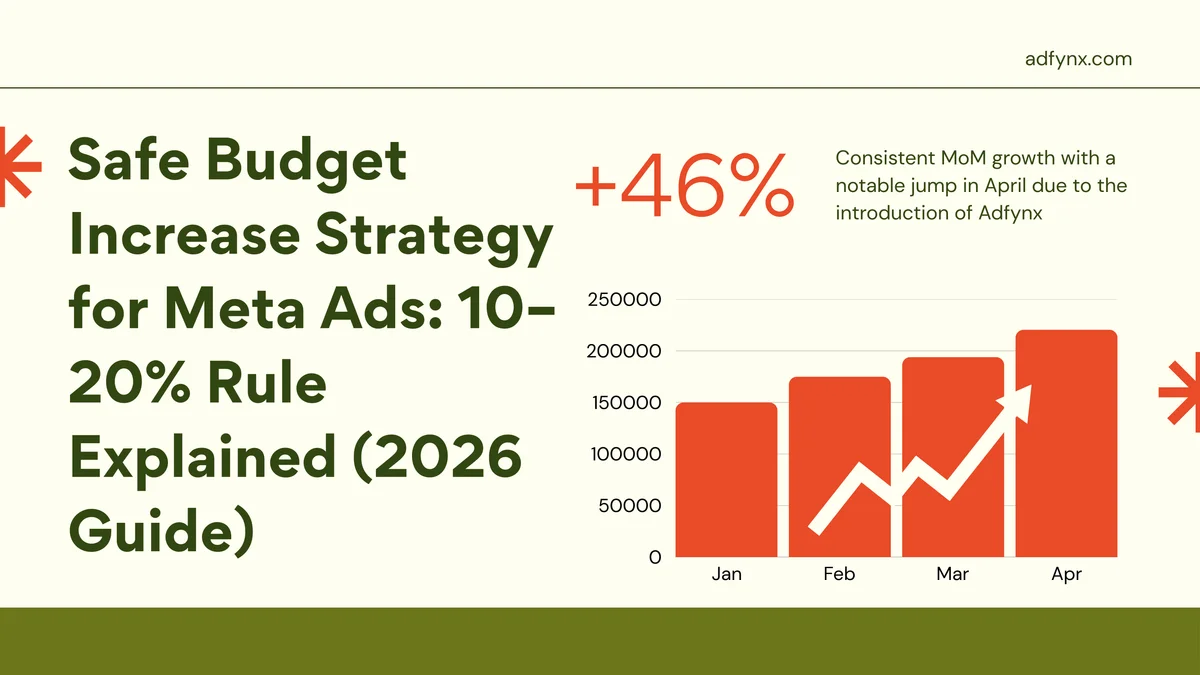
Safe Budget Increase Strategy for Meta Ads: 10–20% Rule Explained (2026 Guide)
Master safe Meta ads budget scaling with the proven 10-20% daily increase rule. Learn optimal timing (target region midnight), threshold limits (20% safe, 30-50% aggressive, >50% triggers learning reset), vertical vs horizontal scaling approaches, and when to break the rule for breakthrough scaling with broad targeting strategies.
Subscribe to Our Newsletter
Get weekly AI-powered Meta Ads insights and actionable tips
We respect your privacy. Unsubscribe at any time.