
How To Test Facebook Ads on a Tiny Budget Without Burning Cash?
A practical, repeatable framework to test Facebook ads on small budgets, identify winners, and scale only when the data says it is time.
When budgets are tight, the first casualty is signal. Random tweaks turn into expensive guesses, and scaling becomes impossible. This guide lays out a practical, repeatable framework to test Facebook ads on small budgets, identify winners, and scale only when the data says it's time.
The Framework at a Glance
Test with ABO, scale with CBO.
ABO (Ad Set Budget Optimization) gives each ad set a fair shot; CBO (Campaign Budget Optimization) consolidates spend on proven winners.
Structure: 1 campaign → 5 ad sets → 3 ads per ad set (15 ads total).
$10/day per ad set, launched at 12:00 AM local time for clean pacing.

Three-day cadence with guardrails:
- Day 1 (at 50% spend): If CPM > $70 or CPC > $2–3, turn it off. Purchases? Keep observing.
- Day 2 (at 50% spend): No Add-to-Cart → off; if there's at least one ATC, keep running.
- Day 3 (end of day): No purchase → off; ≥1 purchase → candidate for scale.
Why ABO First?
ABO forces even distribution so each audience-creative pair gets enough impressions to produce a fair read. That's critical on small budgets: signal is your scarce resource. Once you know what works, you move winners into a dedicated CBO scaling campaign.
Day-by-Day Execution
Day 1 — Early signal (check at 50% of daily budget)
- Purchase present? Keep running and watch.
- No purchase? Look at leading indicators:
- Otherwise, let it finish the day.
Day 2 — Mid-funnel sanity check (50% spend)
- No Add-to-Cart (ATC) → turn off.
- ≥1 ATC → keep running.
Day 3 — Outcome check (after full daily spend)
- No purchase → turn off.
- ≥1 purchase → mark as a winner for scaling.

Profitability Math You'll Actually Use
ROAS = Revenue ÷ Ad Spend
Break-even CPA = Price − COGS − shipping − payment fees − other variable costs
Break-even ROAS = Price ÷ Break-even CPA = 1 ÷ gross margin
Scale ROAS = Break-even ROAS × safety factor (e.g., 1.5×)
Example: If your price is $40 and total variable costs are $20, gross margin is 50%, so Break-even ROAS = 2.0. With a 1.5× buffer, Scale ROAS = 3.0.
Scaling with CBO (Only When Ready)
Create a separate CBO scaling campaign and copy in only the winning ad sets and their best ads.
Starting daily budget: about $150 (adapt to your size).
At 50% spend (ad set level):
- No purchase → turn off in the CBO; let it keep soaking in the ABO test a bit longer.
- Has purchase → allow it to complete the day.
After 1 full day (campaign level):
- ROAS ≥ Break-even → run another 48 hours to confirm stability.
- ROAS ≥ Scale ROAS → increase budget 20–50% every 48 hours. Avoid constant edits that reset learning.

What to Fix When Metrics Look Off
High CPM, OK CPC → audience or auction pressure. Try broader targeting, new geos, or stronger hooks to lift CTR further.
OK CPM, high CPC → creative isn't resonating. Sharpen the first 3 seconds: promise, proof, and offer.
Healthy CPM/CPC but no ATC → landing page friction (slow load, unclear benefit/price, weak trust). Fix the page before you blame the ads.
Common Pitfalls to Avoid
- Mixing testing and scaling in one campaign.
- Editing budgets/ads too frequently (batch every 48 hours).
- Spreading micro-budgets across too many ad sets.
- Inconsistent attribution windows (pick one like 7-day click / 1-day view and stick to it).
- Poor message match between ad and landing page.
- Ignoring mobile speed (a slow page will make good ads look bad).
Implementation Checklist
1. ABO test: 5 ad sets × 3 ads; $10/day each; launch at 12:00 AM.
2. Day 1 @ 50%: Purchases? keep; else CPM > $70 or CPC > $2–3 → off.
3. Day 2 @ 50%: ATC = 0 → off; ≥1 → keep.
4. Day 3 end: Purchases = 0 → off; ≥1 → candidate for scale.
5. Compute Break-even ROAS; set Scale ROAS (e.g., ×1.5).
6. CBO scale: add winners; check at 50%; validate 48h; raise budget 20–50% every 48h once Scale ROAS is met.
Conclusion
Small budgets don't have to mean small results. If you protect signal with strict guardrails and only scale after you clear your Scale ROAS, you'll cut waste and still give winners room to grow.
---Need help planning your ad budget? Use our free Facebook Ads Cost Calculator to estimate your monthly spend, CPA, ROAS, and budget allocation.
---Ready to simplify your Facebook ad reporting and analysis? Get AI-powered insights and automated reports to track your ROAS, CPA, and campaign performance. Try Adfynx for Free
You May Also Like
Meta Ads Budget Distribution Explained: CBO vs ABO Strategy Guide for 2026
Master Meta ads budget distribution with the complete CBO vs ABO comparison. Learn when to use Campaign Budget Optimization (algorithmic distribution, 3-4 ad sets for small budgets, 7-10 for large) vs Ad Set Budget Optimization (manual control, testing scenarios), optimal ad set quantities by budget level, and why the 20% scaling rule is obsolete in 2026's AI-driven algorithm.
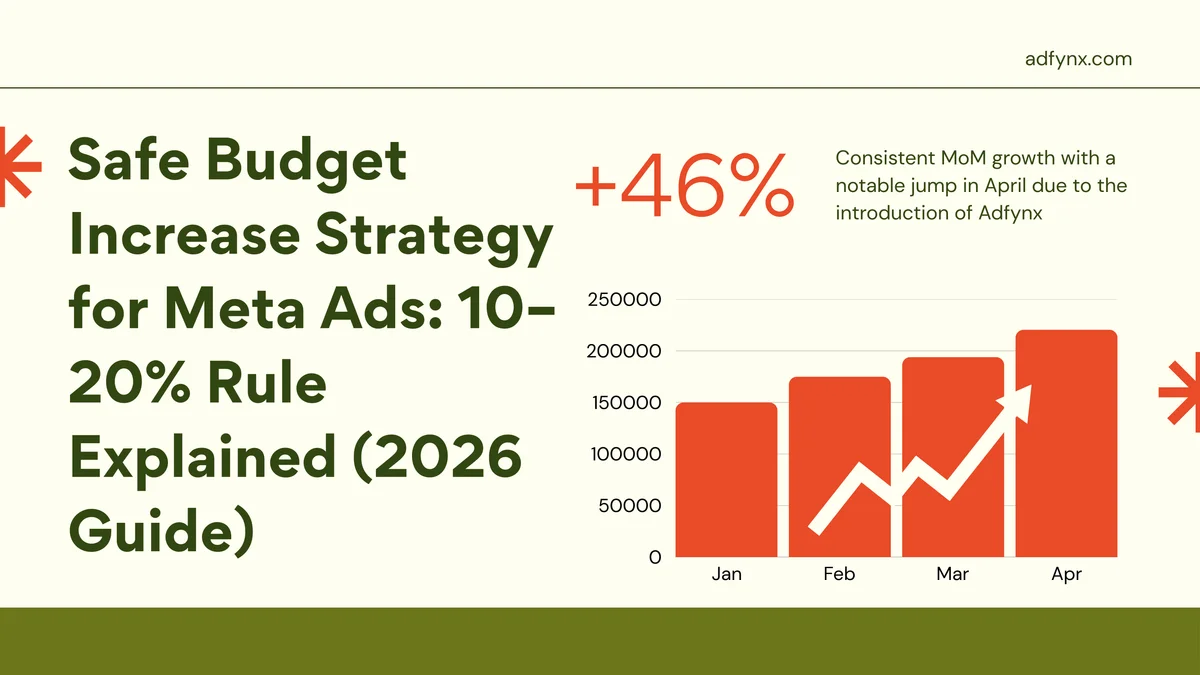
Safe Budget Increase Strategy for Meta Ads: 10–20% Rule Explained (2026 Guide)
Master safe Meta ads budget scaling with the proven 10-20% daily increase rule. Learn optimal timing (target region midnight), threshold limits (20% safe, 30-50% aggressive, >50% triggers learning reset), vertical vs horizontal scaling approaches, and when to break the rule for breakthrough scaling with broad targeting strategies.
How to Lower CPM on Facebook Ads: 10 Proven Strategies to Reduce Costs in 2026
Lower your Facebook CPM with 10 data-driven strategies: budget control, frequency management, audience optimization, relevance score improvement, creative testing, social proof integration, timing optimization, CTA enhancement, bidding strategy refinement, and placement selection. Includes 2026 benchmarks, step-by-step frameworks, and actionable tactics to reduce ad costs by 15-40%.
Subscribe to Our Newsletter
Get weekly AI-powered Meta Ads insights and actionable tips
We respect your privacy. Unsubscribe at any time.